Why Do K-pop Albums Have Multiple Versions? What Is Inside a Physical Album
Why K-pop albums come in several versions, and what you usually find inside one: photobook, photocards, poster and more.
Look up a K-pop album in an online store and you will often find three, four or more versions of the same release. Here is why that happens and what you can expect to find inside the box.
What “versions” means
A version is a different physical edition of the same album. The music is normally identical. What changes is everything around it: the cover, the photos, the packaging and sometimes the small extras.
Versions are usually named after the album’s concepts, with words, letters, colors or numbers. Some releases also have member versions, where each cover features a different member.
Why there are multiple versions
There is no single official reason. These are the explanations given most often:
- Concepts. A comeback often has more than one visual concept, and each version gives one of them its own photobook.
- Collectibility. In K-pop, a physical album is as much a collectible as a way to listen to music. Different covers give collectors something to choose from, or to complete.
- Random extras. Photocards and other inclusions are usually random, so some fans buy more than one copy while looking for a card of their bias.
- Support for the artist. Physical sales count toward album charts and are one of the factors on some music shows, so buying copies is a common way to support a comeback.
What is usually inside a physical album
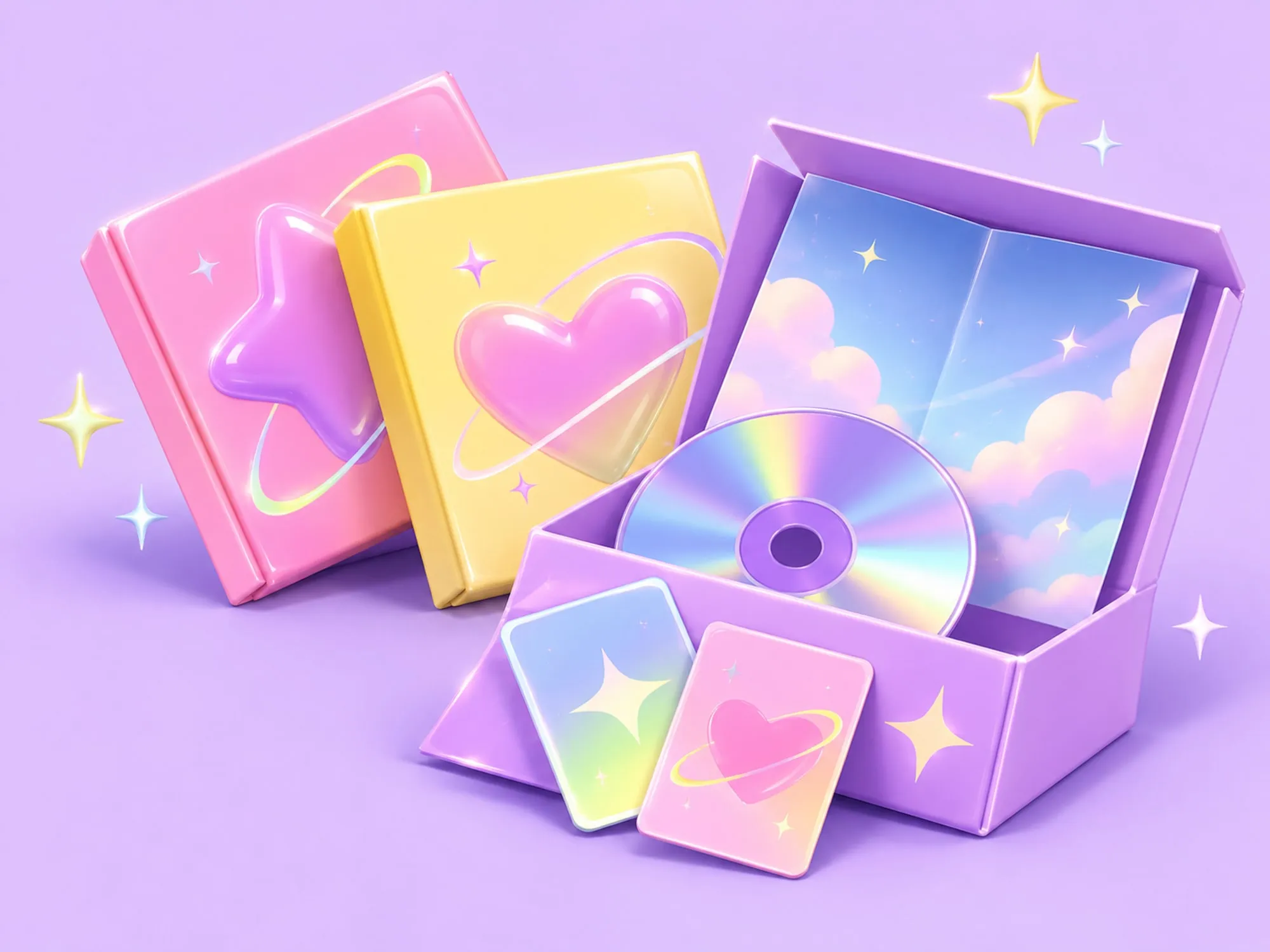
The contents change with every release, but most albums include a mix of the following. Fans call these items inclusions.
- CD: the disc with the music, often printed with its own artwork.
- Photobook: a booklet of concept photos, from a few pages to something close to a small magazine.
- Photocards: one or more small collectible cards, usually picked at random from a larger set.
- Lyric book or lyric sheet: the lyrics and credits, sometimes built into the photobook.
- Poster: often folded inside the package. Rolled posters, when offered, usually come separately from the store.
- Small extras: postcards, stickers, bookmarks, film strips or similar items that vary by album.
Two more terms come up when you shop. A first press extra is included only in the first batch of copies. A POB, or pre-order benefit, is a gift added by a specific store and is not inside the sealed album.
Common album formats
Besides the concept versions, the same release can come in different formats:
- Photobook version: the standard, larger edition with the most pages.
- Compact versions: slimmer packages, such as jewel cases or digipacks, with fewer inclusions.
- Digital or platform versions: small packages with photocards and a code or card that unlocks the music and photos in an app, instead of a CD.
- Limited editions: special packaging or a vinyl record, produced in smaller quantities.
Lighter formats have become more common in recent years, partly because of concerns about packaging waste.
How to choose a version
You do not need every version to be a fan. A few questions make the choice easier:
- Which concept do you like most? Before a release, agencies usually publish images showing each version’s cover and contents.
- What do you actually want? If it is the photobook, pick the full edition. If it is mostly the photocards, a compact version may be enough.
- Can you choose? Some stores let you select the version, while others ship one at random.
- Is anyone sharing? Friends and fan groups often split a set or trade inclusions afterwards.
Quick summary
Multiple versions exist largely because K-pop albums are designed as collectibles: same songs, different looks and random extras. Check the contents list before buying and choose the one that fits what you want from it.